Mega Sale Domains @ Rs.99

Wednesday, November 30, 2011

Step Three - Understand the Color Wheel

Step Three - Understand the Color Wheel

The color wheel is a universal chart which shows how all colors are created from just three basic (primary) colors. Here's how it goes...

Primary Colors (inner circle) - Red, Yellow, and Blue

Secondary Colors (middle ring) - Orange, Green, and Purple
Secondary colors are made by mixing 2 primary colors together:

  • Red + Yellow = Orange
  • Red + Blue = Purple
  • Blue + Yellow = Green

Tertiary Colors (outer ring)
Created by mixing primary and secondary colors together:

  • Yellow + Orange = Orange/Yellow
  • Yellow + Green = Yellow/Green (lime green)
  • Blue + Green = Blue/Green
  • Blue + Purple = Blue/Violet
  • Red + Purple = Red/Violet
  • Red + Orange = Red/Orange
Why is the hair color wheel so important?...

1) All hair color is comprised of different ratios of the primary colors (red, yellow, blue).

2) It clearly illustrates which colors neutralize which...find the primary color you want to tone away and look directly across the chart to the opposite secondary color.

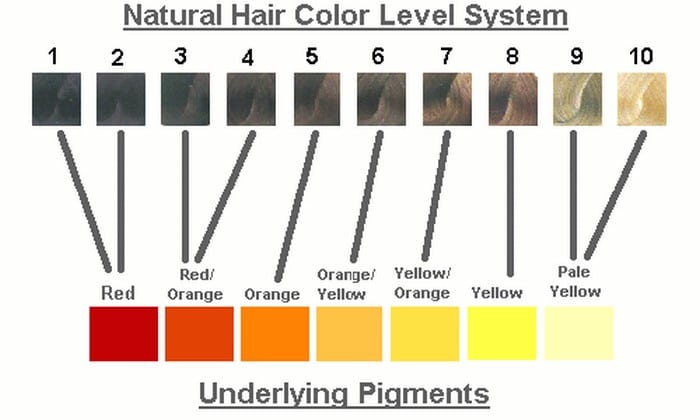
Step Two - Identify Your Underlying Pigment

Step Two - Identify Your Underlying Pigment

Hair color chart.


A hair coloring process that involves any amount of hydrogen peroxide (which can include some semi-permanent formulas) will bring out the natural underlying pigment of your hair.

The "natural looking" tone that's visible as your hair color is not the true tone when it comes to the chemistry of hair coloring.

Think of it as a surface layer that's stripped away, and laying in wait underneath are the bold and brassy tones of your underlying pigment.

The chart above clearly illustrates which color of underlying pigment corresponds with the natural level you identified in step one. So now you know what you're dealing with.

Step One - Identify Natural Haircolor Level

Step One - Identify Natural Haircolor Level

An international system is used to identify the level of darkness of your hair, 1 being the darkest (black) and 10 being the lightest (blonde). Match your hair (just the regrowth if it's previously colored) to the hair color swatch below that most closely resembles the darkness of your haircolor...not necessarily the tone, which could be warm(red), cool(ash), or neutral, but the degree of lightness or darkness.

Hair Coloring Success

Hair Coloring Success

The Hair Color Wheel


There are some very specific rules that come into play with hair coloring.

This page outlines the basic chemistry involved and highlights some of the most critical rules to keep in mind.

Knowing where you're starting, where you're going and what to expect along the way is the best way to ensure good results from your color.

Here's the formula... nice 'n simple...

FINISHING COLOR

FINISHING COLOR

Either permanent or semi-permanent will work for the finished color. Permanent is better if you've gone a bit overboard with the filler and need a formula with a bit more oomph to neutralize out more of the orange. Otherwise, go with semi(or demi)-permanent.

Semi-permanent is deposit only, which is exactly what you need to get your hair darker. There's no need for the ammonia and peroxide contained in permanent colors when all you want to do is deposit a darker color. So semi-permanent is always my personal choice for that purpose.

Semi-permanent pigment is also more likely to fade, and you may find that to be a good thing. Especially on extremely porous hair which can end up going darker than expected.

If it fades, simply re-apply as needed.

Or prevent color loss by using a colored shampoo and conditioner like icon. These special pigmented cleansers and conditioners deposit a slight color on your hair which deepens your shade and keeps your color looking fresh.

Color Back

Color Back

From Light to Dark Hair


A color back is the process of taking an artificial blonde back to a darker shade.

There are a few essential steps for getting an even, natural looking color that will last.

This article will take you through the process so you can avoid any mishaps.

A blue/grey/green cast is a common outcome with a color back process.

The blonde hair is over-porous and will absorb the blue pigments in the color formula moreso than the red and yellow. So adding some of those warm pigments back to the hair is important.

Hair Color Articles

Hair Color Articles
Expert Advice for Optimal Results


Questions about hair color? This page offers articles with professional advice on a wide range of processes from highlighting hair with foils to coloring grey hair, and more.

Oh, the tantalizing array of choices. Something new every season. New products, new trends... Limitless possibilities!

Exciting?... You bet! But the range of options can also be overwhelming. Boxes of color, row upon row, it can all become a bit of a blur.

These articles will help to demystify the art and science of coloring your own hair.